.png)

FDA-Compliant, Yet Still Sued? The Labeling Risks U.S.-Bound Brands Often Miss

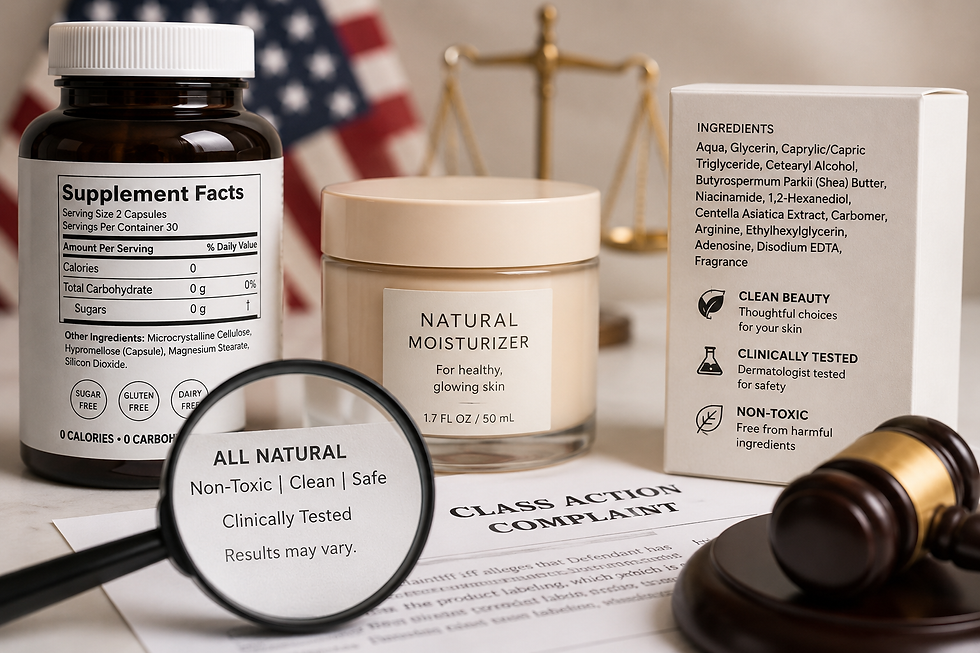
The Hidden Labeling Risks American Beauty and Inner Beauty Brands Are Missing
When preparing to enter the US market, most brands fixate on FDA registration and MoCRA compliance. Once the ingredient list is formatted according to regulation and the label design is set, it is easy to assume you’re in the clear.
However, a significant portion of the lawsuits that actually threaten brands in the US market do not originate from the FDA. Instead, they stem from class-action lawsuits weaponized by state consumer protection laws.
Lawsuits Quietly Creep Up on You
A recent case in the US involved a dietary supplement labeled as having “0 calories” and “0 carbohydrates.” A consumer lawsuit was filed based on the claim that actual lab tests contradicted these statements. While the case has yet to reach a final verdict, the court allowed the lawsuit to proceed in its early stages based solely on a single lab test provided by the consumer.
The beauty industry is facing a similar wave of litigation. Since the second half of 2024, several skincare brands have found themselves targeted by back-to-back class-action lawsuits simply for featuring the word “Collagen” prominently on the front of their products. Plaintiffs argued that the front label led them to believe the product contained actual collagen, when it actually utilized plant-derived alternatives.
The crux of the matter was not the ingredient list on the back, but rather the consumer expectation created by the word “Collagen” on the front. One of these brands ultimately settled the dispute for a staggering $9.2 million.
This Doesn’t Wait for an FDA Investigation
These cases do not necessarily trigger after an FDA probe.
In the US consumer market, specialized class-action law firms actively monitor labeling terms and marketing claims. If they spot a widely used industry term that they believe could mislead consumers, they will purchase the product themselves, order lab testing, and initiate a legal review.
For brands, this means facing a sudden legal battle without ever receiving a single warning from the FDA.
FDA Compliance and Consumer Class Actions are Completely Different Ballgames

Many Korean brands preparing for a US launch prioritize procedures like FDA registration, MoCRA compliance, and facility registration. While these are undeniably critical, success in the US market depends just as much on how a consumer perceives your label as it does on whether you are registered with the FDA.
Phrases like “natural,” “clean,” “non-toxic,” “clinically tested,” or “sugar-free” might feel like standard, harmless marketing jargon to a brand. In the US, however, the legal benchmark hinges on the exact expectations those words create in the mind of the consumer.
A consumer might interpret “sugar-free” to mean absolutely zero sugar, expect “clean” to mean the total absence of certain ingredients, or assume “clinically tested” implies a rigorous level of testing that matches their own assumptions.
In short, even if the product itself is perfectly safe, a dangerous legal risk arises the moment a gap forms between consumer expectation and product reality.
Inner Beauty and Dietary Supplements Face Even Higher Scrutiny

The same applies to inner beauty products like collagen drinks, skin-glow supplements, and beauty gummies. If a label claims a product “contains collagen” or “replenishes hyaluronic acid,” it establishes a baseline expectation regarding its actual content and quality. If those ingredients are missing or replaced with alternatives that are not functionally equivalent, the product falls into the exact same litigation trap as cosmetics.
Furthermore, translating Korean functional claims literally can invite separate hazards; phrases like “improves fine lines” or “promotes collagen production” are classified as drug claims under FDA standards, creating an entirely different layer of risk.
High-Risk Labeling Patterns to Avoid
These are the recurring patterns seen in actual lawsuits:
Discrepancies Between Front Labels and Actual Ingredients: Clarifying that an ingredient is a plant-derived alternative on your website means nothing if it isn't on the packaging. Offline shoppers won't have that context.
Unverified “Natural,” “Clean,” or “Free From” Claims: Labeling a synthetically processed ingredient as “naturally derived” or boasting a “clean” formula without concrete criteria. Even global mega-brands have faced class actions over these exact terms.
Inconsistencies Across Packaging, Website, and Social Media: Consumers must see a consistent message regardless of the channel. Discrepancies between platforms serve as perfect ammunition for a lawsuit.
Absence of the Hero Ingredient Justifying a Premium Price: When the very ingredient that justified a premium price is missing or substituted. The quintessential class-action narrative is: "I bought it specifically for that ingredient, but it wasn't there."
A Label is a Legal Promise, Not Just Marketing
While FDA registration and MoCRA compliance are mandatory prerequisites for entering the US market, they are not a shield against everything. Labels and marketing build consumer expectations, and legal disputes ignite the moment those expectations crash into reality. Now is the time to audit every channel—packaging, websites, and social media—to ensure your claims seamlessly align with what is actually inside the bottle.
Provision Consulting Group reviews not only FDA regulations but also labeling claims, ingredient declarations, and potential consumer deception for cosmetics, inner beauty, dietary supplements, OTC, and medical devices entering the US market. If you are preparing to launch or need a risk assessment of your current labels, mitigate unnecessary legal risks through our pre-launch review services.
For inquiries or expert assistance, please contact us today.
CONTACT US
Office: 1-909-493-3276
Email: ask@provisionfda.com